October 23, 2026
How to Label Solar Components Before Roof Work
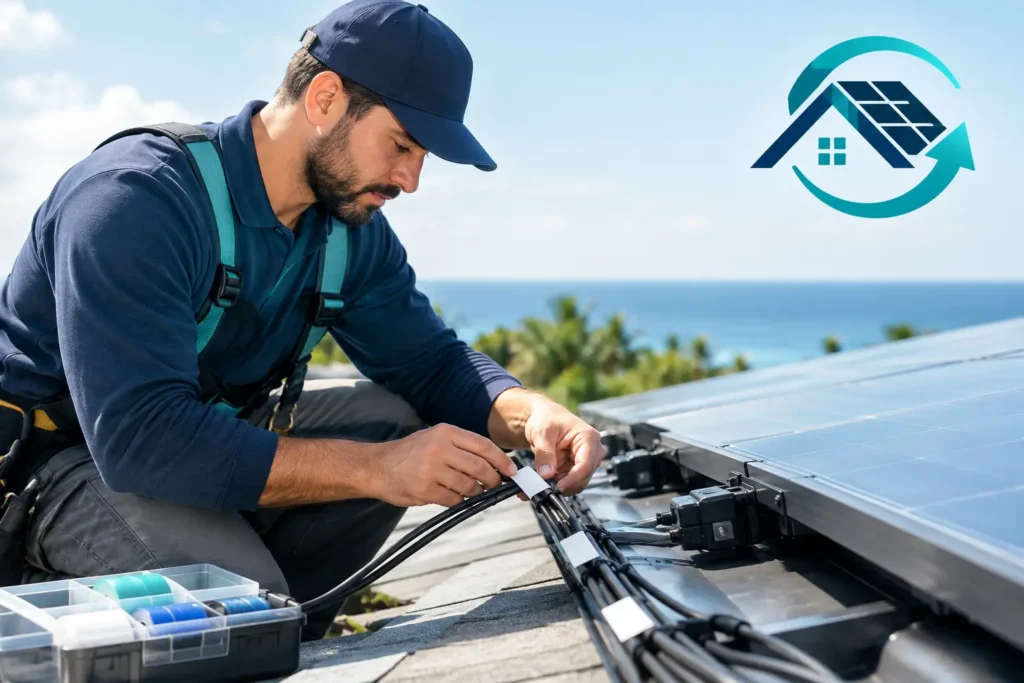
A roof replacement can require an installed PV array to come down, but the equipment should never become a collection of anonymous panels, rails, and wires. To label solar components properly is to preserve the system’s physical and electrical story before roof work begins. That record helps the solar team return each item to its intended location, gives the roofer a clear work area, and gives the homeowner better documentation at closeout.
For Central Florida homeowners, this detail matters after storm damage, during roof repairs, and when a roof has reached the point of replacement. Solar equipment is a substantial asset. Organized labeling, paired with photographs and controlled staging, protects that asset from the confusion that can occur when multiple trades are working against a schedule.
Why labeling matters during a PV detach and reset
Solar arrays may look repetitive from the ground, but the equipment is not interchangeable in practice. Panel positions can correspond to a particular row, roof plane, mounting layout, wire route, or equipment configuration. Rails are cut and fitted to a specific array design. Flashing, attachments, junction boxes, conductors, and grounding components all need to be handled with attention to where they belong and what condition they were in before work started.
A clear labeling process creates continuity from the initial assessment through reinstallation. It allows the solar crew to compare the completed array with pre-work documentation rather than relying on memory or assumptions. It also reduces avoidable questions when roof conditions, replacement materials, or scheduling changes affect the original plan.
Labels alone are not the full answer. They work best as one part of a documented process that includes pre-work photos, array mapping, equipment condition notes, protected staging, and final operational checks. Craft over shortcuts means treating each panel and connection as part of one protected system.
What should be documented before components move
The most useful labels are simple, durable, and tied to records the project team can understand later. A label such as “north roof, row 2, panel 4” is more useful than a mark that only makes sense to the person who wrote it. The goal is traceability, not unnecessary complexity.
Before a PV detach, the project record should establish the visible layout of the system and the condition of accessible equipment. This may include module locations, rail sections, attachment locations, wire-management paths, junction boxes, conduit runs, rapid shutdown equipment, inverters, and monitoring hardware. Existing manufacturer labels and safety markings should be documented and protected, not obscured or casually removed.
The record should also note conditions that could affect the scope. Examples include damaged modules, worn conductors, corrosion, cracked roof tiles, nonstandard mounting hardware, inaccessible attic areas, or prior repairs. Identifying an existing issue does not mean it is corrected within the detach-and-reset scope. It creates a clear basis for discussing whether additional work, replacement parts, or specialty hardware needs separate approval.
A disciplined pre-work record commonly captures four kinds of information:
- Overview photographs showing the full array and each roof plane
- Close photographs of panel labels, mounting details, wiring paths, and visible equipment condition
- A location map connecting panel rows, rails, and equipment groups to the roof layout
- Written notes identifying observed conditions, access limitations, and items requiring review
This documentation protects everyone involved. Homeowners can see how equipment was arranged before roof work. Roofers receive a defined work zone. The solar crew has a reference for reinstallation. If a question arises later, the project has records rather than recollections.
Label solar components by location, not guesswork
The most dependable system is location-based. Panels are identified according to their roof plane, row, and sequence. Rail sections and related hardware are grouped so they can be returned to their corresponding area. Labels should remain readable through transport and staging without creating damage to the equipment or covering essential factory markings.
Location-based labeling becomes especially valuable on homes with multiple roof planes, separate arrays, additions built at different times, or equipment that has been modified since original installation. A west-facing group may use a different layout than a south-facing group. A detached structure may have its own routing and hardware. Treating all parts as though they belong to one generic pile invites errors.
There is also a limit to what labels can prove. A label identifies where a component was documented before removal. It does not establish that the item is free of hidden defects, compatible with every new roofing detail, or eligible for a manufacturer warranty. Third-party warranty requirements remain subject to the applicable provider’s terms. If an older or damaged component needs correction, that work should be reviewed and quoted separately before it is performed.
Protected staging keeps labels useful
A well-labeled panel can still be damaged by poor staging. Once removed, modules need an organized, protected holding area that reduces the risk of impact, abrasion, moisture exposure, and mix-ups. Padded racks or appropriate support methods help prevent pressure on vulnerable panel surfaces and frames. Hardware should be sorted and contained rather than left loose around an active roofing site.
The staging plan must fit actual site conditions. Limited side-yard space, gated access, pool decks, steep lots, landscaping, weather exposure, and the roofer’s material delivery schedule can all change how equipment is handled. This is why a site-specific assessment matters more than a generic promise.
Good staging also supports the roofer’s progress. Solar equipment should be removed from the work area in a way that allows the roofing crew to address the necessary sections without repeatedly moving panels or hardware. The handoff should be clear: the roof is ready for the agreed work, the solar equipment is accounted for, and the schedule for return is coordinated rather than assumed.
Reinstallation needs a record, not a reconstruction guess
After the roof work is complete and the roof area is ready, the same labels and photographs guide precision reinstallation. The objective is not merely to place panels back on the roof. It is to reinstall the mounting and array in accordance with the approved scope, the roof’s completed condition, and the documented layout.
During this stage, a qualified solar team reviews the applicable mounting work, attachment details, rail alignment, panel placement, wire management, and accessible electrical connections. If the crew finds a condition outside the original scope – such as missing hardware, a failed component, damage discovered during handling, or an incompatibility created by prior work – it should be brought forward for approval. Quietly substituting parts or proceeding around a problem may create larger concerns later.
This is also where coordination matters most. Roofing completion, cure times where applicable, weather, material availability, safe access, and required approvals can affect the reinstallation date. A responsible schedule identifies who owns each handoff instead of leaving the homeowner to chase updates between trades.
Closeout testing provides a useful point-in-time record
Once the array is reinstalled, the project should close with documented observations rather than broad promises. A final production or operational check can record observed system status, accessible measurements, monitoring information where available, and any unresolved faults identified at that time.
That distinction is important. A test can document observed operation on the day of service, but it cannot guarantee future production or eliminate unrelated existing problems with utility service, monitoring communications, inverter behavior, shading, aging components, or other equipment outside the defined scope. Clear records are more valuable than vague assurances.
At closeout, homeowners should understand what was completed, what was observed, and what may require separate attention. For PV detach-and-reset workmanship performed by Remove and Restore Solar LLC, the company offers a 10-year leak and labor workmanship warranty at no additional cost. Replacement components, specialty hardware, and additional corrective work are separate when needed and should be approved in writing.
If your roof project requires solar removal in Melbourne, Brevard County, or elsewhere in Florida, call the office at 321-322-7746 to discuss scheduling. For an accurate estimate, have your roof-work timing, panel count, roof type, site-access details, and any known solar concerns available. A carefully labeled system gives every trade a clearer path forward – and gives the homeowner a better record of what was protected along the way.